

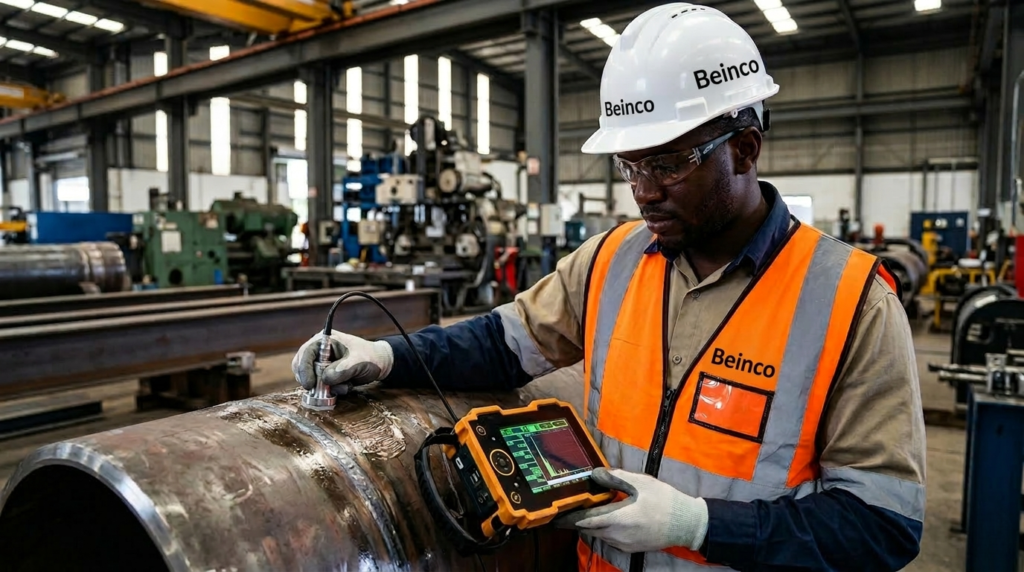
Our NDT Capabilities
We offer a range of industry-standard non-destructive testing techniques to identify defects such as cracks, corrosion, weld failures, material fatigue, and structural weaknesses.
Visual Inspection (VT)
Visual Testing is the first and most fundamental NDT method. Our trained inspectors perform detailed examinations of equipment, welds, pipelines, tanks, and structural components to identify visible defects, corrosion, deformation, or misalignment.
Ultrasonic Testing (UT)
Ultrasonic Testing uses high-frequency sound waves to detect internal flaws or measure material thickness. It is widely used to inspect pressure vessels, pipelines, storage tanks, and structural components.
Magnetic Particle Testing (MT)
Magnetic Particle Testing is used to detect surface and near-surface defects in ferromagnetic materials. This method is ideal for identifying cracks, seams, and discontinuities in welds and structural components.
Dye Penetrant Testing (PT)
Dye Penetrant Testing is used to reveal surface-breaking defects such as cracks or porosity in metals and non-porous materials. It is commonly applied to weld inspections, machined parts, and structural components.
Radiographic Testing (RT)
Radiographic Testing uses X-rays or gamma rays to inspect the internal structure of materials. This method is effective for detecting internal flaws, weld defects, and structural inconsistencies.
Thickness Testing
Using ultrasonic thickness gauges, we measure material thickness to monitor corrosion, erosion, or wear in pipelines, tanks, and pressure vessels.
Industries We Serve
We provide NDT services to clients across multiple sectors, including:
- Mining and mineral processing
- Oil and gas facilities
- Manufacturing plants
- Power and energy infrastructure
- Construction and engineering projects
- Water and wastewater facilities
- Transportation and logistics infrastructure
